Choosing a Pallet Storage Racking System is not just a matter of counting beams and uprights. The right design must suit the products, forklifts, aisle widths, and daily picking patterns inside a real warehouse. A rack can look impressive in a catalogue and still waste floor space.
Industry data shows why buyers are paying closer attention. MHI’s 2024 Annual Industry Report found that 55% of surveyed supply-chain leaders planned to adopt robotics and automation within five years. That figure concerns supply-chain technology broadly, not pallet racking alone. Still, it points to a practical question: will the rack layout support future equipment, or force costly changes later?
Warehouse-design expert Dr. Edward Frazelle, author of World-Class Warehousing and Material Handling, emphasizes aligning warehouse design with operational needs. A concise paraphrase of that principle is: “Design storage around the operation, not the other way around.” This is a paraphrase, not a verified verbatim quotation.
This guide examines China’s leading manufacturers through the details buyers can check: engineering capabilities, load information, product range, quality controls, and after-sales support. Look beyond polished factory photos. Ask how a supplier handles unusual pallet dimensions, expansion plans, and replacement parts. Those details matter when a forklift enters a narrow aisle on a busy shift. Manufacturer rankings also have limits; public data is uneven, and a large production capacity does not automatically mean a better fit. The strongest choice is the one that matches your facility’s actual risks and workflow.
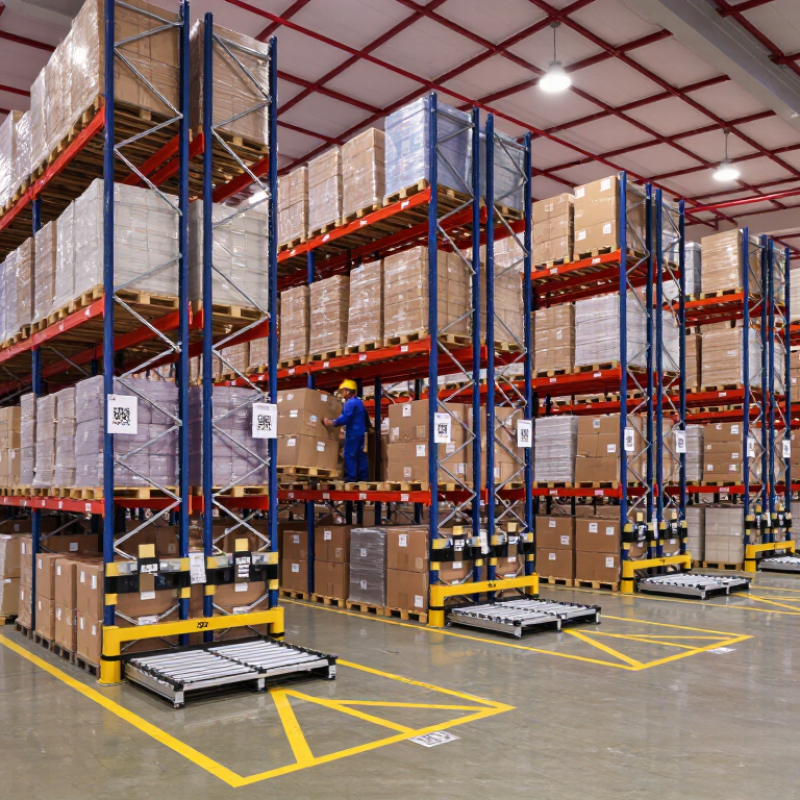
What Is a Pallet Storage Racking System?
A pallet storage racking system is a steel structure that holds palletized goods above the floor. Upright frames support horizontal beams, creating shelf levels that forklifts can access. A typical bay might store two pallets side by side, with clear labels showing each level’s load limit. Simple in concept. Exact design matters.
Rack style affects how a warehouse uses space and retrieves stock. Selective racking gives forklifts direct access to each pallet, while denser designs may place pallets several positions deep. The trade-off is practical: higher storage density can mean fewer access routes. A layout that looks efficient on paper may feel awkward when forklifts turn with wide loads. That detail is easy to miss.
Good system planning starts with pallet size, product weight, handling equipment, and inventory turnover. Beam heights should leave room for safe lifting, and aisles must suit the actual forklift, not an idealized drawing. Load ratings need to match the stored goods and be clearly communicated. Racking also requires inspection for bent uprights, loose connections, and impact damage. Small defects can matter. Conditions vary by facility, so a qualified storage professional should verify the design, installation, and applicable local requirements.
| System or Evaluation Area | How It Works or What to Check | Typical Fit and Trade-Offs | Evidence to Request from a Manufacturer |
|---|---|---|---|
| Selective pallet racking | Each pallet position is directly accessible from an aisle, typically using a forklift. | Offers high selectivity and straightforward stock rotation. Aisles occupy floor space, so storage density is generally lower than in deep-lane systems. | Ask for a layout based on the actual pallet sizes, load weights, forklift dimensions, aisle requirements, and building conditions. |
| Double-deep racking | Stores pallets two positions deep, generally requiring a reach truck or another suitable handling method. | Can increase storage density compared with selective racking, but the rear pallet is less directly accessible and stock rotation needs planning. | Confirm equipment compatibility, required clearances, load configuration, and the procedure for accessing rear pallet positions. |
| Drive-in or drive-through racking | Forklifts enter storage lanes to place or retrieve pallets. Drive-in lanes are commonly accessed from one end; drive-through lanes can be accessed from both ends. | Uses space efficiently for large quantities of similar products. Selectivity is lower than selective racking, and operating rules must account for lane access and pallet sequence. | Request lane-loading instructions, impact-protection details, and a design that reflects the intended loading sequence and operating equipment. |
| Push-back racking | Pallets are loaded and retrieved from the aisle side on nested carts or other engineered mechanisms; loading a new pallet moves stored pallets back. | Provides multiple pallet positions per lane while retaining aisle-side access. It is generally suited to storing several pallets of the same product, rather than one-pallet-per-SKU access. | Check the system's approved pallet and load specifications, operating instructions, maintenance requirements, and compatibility with the planned forklift. |
| Pallet-flow racking | Gravity roller tracks move pallets from a loading side toward a picking side. | Can support first-in, first-out (FIFO) stock rotation when correctly configured. Pallet condition, dimensions, and consistent loading are important to reliable operation. | Ask for track design details, pallet suitability criteria, flow-control provisions, and inspection and maintenance guidance. |
| Shuttle racking | A powered shuttle moves pallets along storage lanes, reducing the need for forklifts to enter the lanes. | Can support dense storage and high-volume lane operations. The design also depends on shuttle equipment, controls, charging, and maintenance arrangements. | Clarify shuttle and rack responsibilities, control-system interfaces, operating limits, spare-parts support, and emergency procedures. |
| Structural design and load data | Rack capacity depends on the complete configuration, including beam spans, frame height, bay layout, pallet loads, bracing, floor conditions, and operating environment. | A single generic capacity figure cannot establish the safe working capacity of a particular installation. | Require project-specific drawings, stated design assumptions, load notices, and engineering calculations for the proposed configuration. |
| Standards and technical documentation | Relevant European standards include EN 15512 for structural design principles, EN 15620 for tolerances, deformations and clearances, EN 15629 for equipment specification, and EN 15635 for use and maintenance. | Applicable requirements depend on the project location, contract, and local regulations. A standards reference alone does not demonstrate that a particular installation complies. | Ask which standards and regulations apply, what documents demonstrate conformity, and whether the design has been checked for the actual site and operating conditions. |
| Manufacturing quality and traceability | Assess material specifications, production controls, dimensional checks, coating processes, and how components are identified and traced. | Consistent production and clearly identified components help support installation, inspection, and replacement over the system's service life. | Request quality-system documentation, inspection records, product specifications, and a clear component identification method. Verify certificates directly with their issuing bodies where applicable. |
| Installation, inspection, and after-sales support | A pallet racking system requires correct assembly, safe operation, and ongoing inspection and maintenance. | Support arrangements matter for facilities that operate continuously or depend on specialized equipment and spare parts. | Confirm installation scope, handover documents, inspection guidance, damage-reporting procedures, warranty terms, and availability of replacement components. |
| What is a pallet storage racking system? It is a storage structure designed to hold palletized goods in defined positions and provide access for handling equipment. There is no single universally accepted public ranking of Chinese manufacturers in this table; it compares system types and practical criteria for evaluating suppliers without naming companies or brands. Final selection and capacity should be based on a site-specific design and applicable local requirements. | |||
FAQS
It stores palletized goods above the floor on steel frames and beams. Forklifts access the stored pallets.
Pallet dimensions, product weight, forklift type, and inventory turnover all matter. A wide load may need more turning space.
Selective racks provide direct access to each pallet. Denser systems store pallets deeper, but may reduce access routes. Trade-offs are real.
Request layout drawings, load calculations, material details, inspection records, and examples of similar installations. A product list alone is not enough.
Teams survey the site, check pallets and equipment, then plan beam levels and aisle widths. Steel parts are cut, welded, and coated.
Compare the documented ratings with actual pallet weights, not rough estimates. Ask how uneven loads affect capacity. Small differences matter.
Check for bent uprights, loose connections, damaged beam connectors, and impact marks. Even a small defect deserves attention.
Aisles must suit the equipment and its loads. An ideal drawing can miss a tight turn. Easy to overlook.
Conclusion
A Pallet Storage Racking System is a warehouse storage structure designed to hold palletized goods and make inventory easier to organize, access, and move. China’s pallet racking industry includes manufacturers with different areas of focus, such as standard rack production, customized warehouse layouts, and integrated storage solutions. Their capabilities and product ranges can vary, so the label “top manufacturer” is best understood in terms of performance and suitability rather than size alone.
Buyers can assess manufacturers by comparing engineering expertise, material quality, production capacity, customization options, safety considerations, delivery schedules, and after-sales support. It is also important to check whether a proposed system fits the warehouse’s available space, load requirements, handling equipment, and plans for future expansion. A careful comparison of specifications, project experience, service terms, and total costs can help buyers select a dependable supplier for their warehouse needs.