High-Performance Storage Equipment & Automation
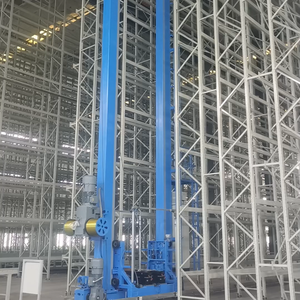
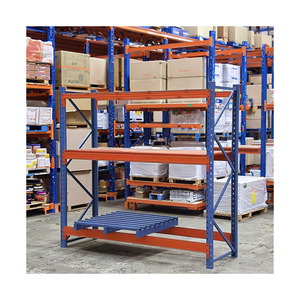
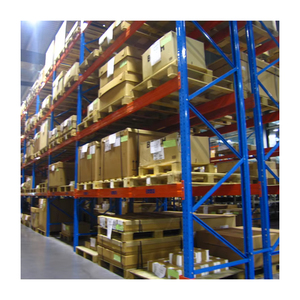
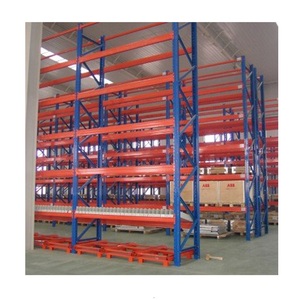
Custom-engineered racking assemblies manufactured from precision roll-formed cold-rolled profiles, accommodating loads from light bins up to 4,000 kg heavy-duty unitized pallet loads.
Strategic Engineering: Specifying Steel Racking in 2026
Industrial storage is no longer viewed as a passive asset. In modern distribution centers, the physical rack forms the mechanical skeleton for crane automation, AMR paths, and fire suppression plumbing.
High-Grade Metallurgy (Q235B & Q355B)
Reliable manufacturing begins with cold-rolled strip steel certified to high yield strengths. Certified European (EN 10025) and Chinese (GB/T 700) grade equivalents guarantee ductility under shock loading from material handling equipment.
RMI & Seismic Design Standards
Modern layouts require compliance with ANSI MH16.1 specifications and local seismic provisions. Upright baseplate design, floor anchoring torque, and frame tie-in connections are calculated to prevent structural collapse under seismic displacement.
Fire Safety & Flue-Space Control
Integrating NFPA 13 compliance directly into rack design ensures longitudinal and transverse flue spaces are maintained permanently. Row spacers, wire mesh decks, and integrated sprinkler drop channels prevent operational citations.
Warehouse Density vs. Accessibility Evaluation
An objective structural and functional trade-off analysis designed for warehouse logistics planners and material handling procurement teams.
| System Classification | Throughput Velocity | Cube Utilization | Inventory Methodology | Primary Application Profile |
|---|---|---|---|---|
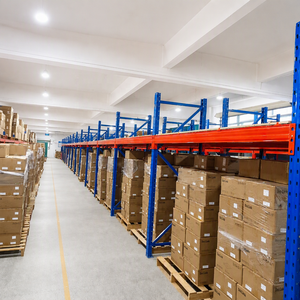
| Selective Pallet Racking | High (100% Direct Access) | Baseline (40% - 50%) | FIFO / Variable | Broad SKU assortments, retail distribution, fast cross-docking. |
| Push-Back Racking | Moderate (Nested Carts) | High (70% - 75%) | LIFO (Last-In, First-Out) | Medium-turnover stock, 2-6 pallet depths, consolidation buffers. |
| Pallet Shuttle Automation | High (Radio/Sensor Shuttle) | Extreme (Up to 85%) | Dynamic FIFO / LIFO | Cold storage facilities, bulk beverage storage, high labor-cost regions. |
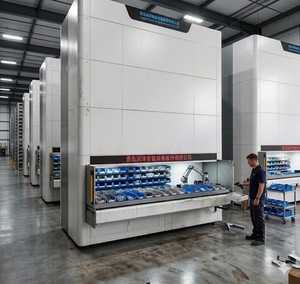
| Vertical Lift Module (VLM) | Ultra-High (Automated Tray Extractor) | Maximum Vertical (85%+) | Software-Controlled Goods-to-Person | High-value tooling, aerospace components, pharmaceutical order picking. |
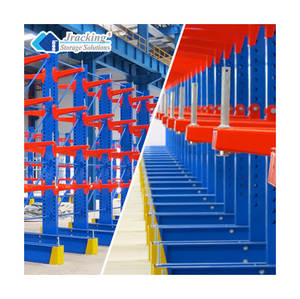
| Cantilever Storage Racks | Continuous Front Opening | Variable Density | Direct Crane / Forklift Access | Extrusions, timber, steel tubing, bar stock, irregular profiles. |
Intralogistics Trends: The 2026–2030 Roadmap
Key technological, operational, and macroeconomic shifts transforming international shelving procurement and distribution infrastructure.
1. Precision Tolerance for Robotics & AMRs
The acceleration of Autonomous Mobile Robots (AMRs) and automated miniload shuttles requires roll-forming dimensional tolerances down to ±0.5 mm. Conventional manual fabrication tolerances are being replaced by automated continuous-punch roll-forming lines.
2. Cold-Chain Resilient Surface Finishes
With global cold-chain logistics surging, powder coating formulation has shifted. Standard polyester finishes are giving way to epoxy-hybrid thermoset powders designed to prevent micro-cracking and delamination under continuous -30°C freezing environments.
3. End-to-End Traceability & Digital QA
International enterprise buyers demand mill test certificates (MTC) linked by coil heat numbers to specific beam and upright batches. Ultrasonic weld testing and automated powder thickness verification are now integrated into factory-acceptance protocol.
Enterprise Manufacturing & Global Delivery Engine
Operating with the discipline of European design standards and the high-volume efficiency of Chinese heavy steel production.
Automated CSA Configuration
Resellers and distributors access standardized automated sizing algorithms, outputting permit-ready load charts, structural deflection calculations, and frame layouts within minutes.
Smart Range 72h Dispatch
Standardized selective frames, stepped beams, and standard block-pallet components are stocked in modular formats, providing express 72-hour container loading for urgent project deadlines.
Dedicated 3-Expert Teams
Every industrial account is managed by three dedicated specialists: a structural Application Engineer, an export Logistics Manager, and an on-site Installation Consultant to coordinate installation permits.
Global Engineering Acceptance
Designs are cross-verified against ANSI MH16.1 (USA), CSA A344 (Canada), and AS 4084 (Australia), streamlining local permit sign-offs with local building inspectors and structural Engineers of Record (EOR).
Frequently Asked Questions on Heavy-Duty Racking Procurement
Straight engineering clarity addressing load tolerances, export tariffs, packaging, and seismic compliance.
What structural steel grades are standard, and how are mill certifications provided? +
We primarily utilize certified Q235B (yield strength ≥ 235 MPa) for light-to-medium profiles and Q355B (yield strength ≥ 355 MPa, comparable to ASTM A572 Grade 50) for heavy upright columns and high-moment beam connectors. Every export bundle includes verifiable EN 10204 Type 3.1 Mill Test Certificates (MTC) documenting chemical analysis and mechanical tensile testing.
How do Chinese manufacturing tolerances align with US and European automated warehouse specs? +
Automated AS/RS and miniload crane systems require vertical deflection tolerances tighter than 1/750. Our production lines use multi-stage roll-forming machines with inline laser monitoring, maintaining beam level tolerances within ±1.0 mm and column perforation pitches within ±0.1 mm, matching FEM 9.831 and RMI standards.
What data is required to provide an initial layout calculation and commercial quotation? +
To produce an engineering layout, please supply: (1) Architectural CAD floor plan showing clear height to bottom of bar joists; (2) Concrete slab thickness and rebar schedule; (3) Unit load parameters including pallet width, depth, overall height, and maximum gross weight; (4) Material handling equipment lift reach and turning radiuses; (5) Local seismic acceleration factors (Ss, S1).
How are long-span cantilever and upright components packaged to prevent damage during ocean transit? +
Uprights are nested face-to-face separated by high-density polyethylene (HDPE) dunnage spacers and strapped with tensioned steel banding over edge-corner protectors. Finished assemblies are shrink-wrapped in micro-perforated VCI (Vapor Corrosion Inhibitor) plastic film to protect against sea freight condensation and salt-fog corrosion.
Can OEM/ODM custom profiles be fabricated for proprietary warehouse product lines? +
Yes. In-house tooling and die facilities allow us to develop custom upright teardrop patterns, speed-lock connector hooks, and proprietary cold-rolled roll shapes. Tooling development typically takes 3 to 4 weeks, with sample testing and structural reporting completed prior to full production runs.
Configure Your Warehouse Architecture Today
Work directly with our structural engineering desk. We review warehouse architectural drawings, calculate pallet densities, and prepare comprehensive tender submissions with certified calculations.
Get a Quote