Engineered OEM Pallet Storage Systems
Explore our foundational structural and cold roll-formed pallet racking configurations. Built from Q235B and high-yield Q355B structural steel, each system is calibrated for precision compatibility with manual forklifts, seismic environments, and automated storage and retrieval systems (AS/RS).
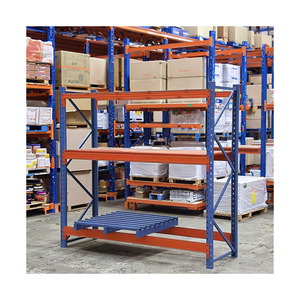
- Load: 1,000–2,500 kg per beam level
- Frame Depth: 800 mm to 1,200 mm custom
- Direct 100% SKU access for logistics centers
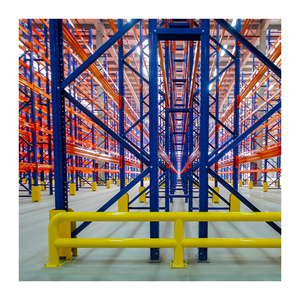
- Capacity: 1,000–4,000 kg/tier capacity
- High-ductility seismic bracing node design
- IBC / UBC Zone 4 compliant structural engineering
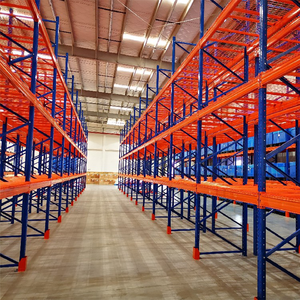
- Profile: Q355B cold-rolled box & step beams
- Maximum upright column section: up to 140 mm
- Ideal for bulky parts and industrial staging
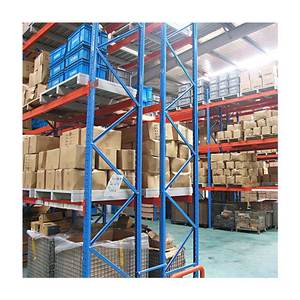
- Safety factor: 1.67–2.0 compliant with RMI standards
- Surface: Thermoset epoxy polyester powder coating
- Designed for heavy pallet turnover environments
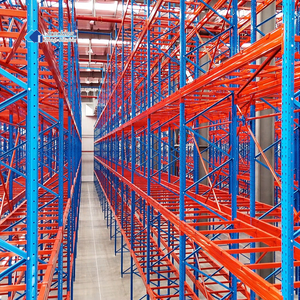
- CE & ISO 9001 certified manufacturing workflow
- Modular 50 mm / 75 mm beam adjustment pitch
- Standard 48"×40" GMA and Euro block pallet ready
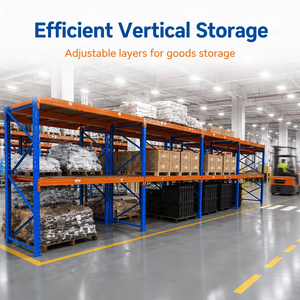
- Custom hole punches: Teardrop, hex, or slotted
- Color matching to client RAL industrial palette
- Bespoke column gauge from 1.5 mm to 3.0 mm
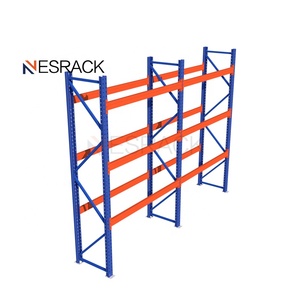
- Container-optimized bundle packaging for zero transit damage
- Up to 15,000 kg total bay frame design load
- Engineered deflection limit restricted to L/200
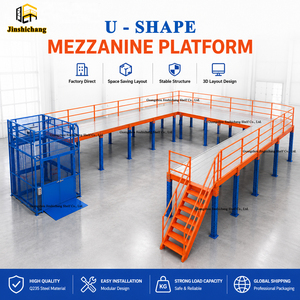
- Floor Load: 300–1,500 kg/m² uniform capacity
- Doubles cubic footprint without civil construction
- Integrated steel stairs, safety handrails, and pallet gates
Future Procurement Trends for Warehouse Pallet Racking (2025–2030)
The global warehousing landscape is experiencing a structural pivot. Logistics facility planners, 3PL operators, and material handling distributors are shifting away from viewing pallet racks as static commodity steel. Modern supply chain procurement focuses on total life-cycle performance, automation readiness, and rigorous cross-border regulatory compliance. As land costs rise and regional labor pools tighten, three distinct procurement vectors dictate warehouse rack acquisition strategies:
Total Cost of Permitting (TCP)
Procurement teams no longer compare base steel prices in isolation. Permitting delays caused by missing PE stamped calculations, non-compliant baseplate anchor sizing, or non-traceable steel mill test reports (MTRs) can stall multi-million-dollar distribution centers. Buyers demand full RMI ANSI MH16.1 (USA) and CSA A344 (Canada) compliance up front to guarantee rapid occupancy permits from the Authority Having Jurisdiction (AHJ).
Hybrid Automation Readiness
While an operation may install standard selective racking today, procurement specifications require rack geometries capable of retrofitting radio shuttle carts, autonomous mobile robots (AMRs), or in-aisle automated reach trucks without structural beam replacements. This demands tighter roll-forming tolerances (±0.5 mm) and pre-drilled guide channel profiles.
Decarbonized & Traceable Steel
Driven by corporate ESG targets and European CBAM / North American environmental mandates, tier-1 retail distributors and global wholesalers prioritize OEM partners utilizing high-recycled-content electric arc furnace (EAF) steel and non-VOC electrostatic powder coatings that support LEED warehouse certification.
Technological Evolution: From Static Iron to Precision Racking Infrastructure
The manufacturing technology of pallet racking has evolved rapidly from manual punch-press operations to automated, high-precision roll-forming lines. The demands of modern 40-foot-tall automated high-bay warehouses require structural tolerances previously seen only in precision mechanical engineering:
1. Finite Element Analysis (FEA) and Non-Linear P-Delta Modelling: Modern pallet racking frames are designed using second-order P-Delta structural simulations that account for column displacement under heavy seismic acceleration. By testing rotational joint stiffness at the beam-to-column connector, our engineering team optimizes section thickness, removing unnecessary dead weight while boosting load safety factors above 1.9.
2. Smart In-Rack Sprinkler Routing and NFPA 13 Compliance: With e-commerce facilities packing high-density plastic totes and combustible packaged goods up to 45 feet, fire code compliance is paramount. Modern OEM rack design integrates internal transversal and longitudinal flue space holders, as well as factory-engineered beam conduit cutouts for ESFR (Early Suppression, Fast Response) and in-rack sprinkler lines.
3. Advanced Anti-Corrosion Finishes for Cold-Chain Integrity: Cold-chain storage environments (-25°C to -30°C) create extreme thermal stress and condensation cycling that degrade substandard paint finishes within months. Leading wholesalers specify thermo-diffused galvanized finishes or specialized zinc-rich epoxy powder primers that prevent micro-cracking and sub-film corrosion, ensuring a 25+ year structural lifespan.
Warehouse Racking Engineering Matrix: System Selection Guide
Selecting the optimal storage geometry requires balancing floor utilization against throughput velocity. The technical matrix below compares standard commercial systems manufactured in our OEM plants:
| Racking Architecture | Inventory Flow | Aisle Width Req. | Density Rating | Optimal SKU Profile | Automation Tier |
|---|---|---|---|---|---|
| Selective Pallet Rack | FIFO / LIFO | 3.0 m – 3.8 m | Baseline (40%) | High SKU count, 100% direct access needed | Manual Counterbalance / Reach |
| Very Narrow Aisle (VNA) | FIFO / LIFO | 1.6 m – 1.9 m | High (65%) | High-density selective storage in premium real estate | Wire-guided VNA Turret Trucks |
| Drive-In / Drive-Through | LIFO / FIFO | Aisle-less block | Very High (75%) | Bulk homogenous SKUs, cold chain, seasonal stock | Forklift drive-in lanes |
| Pallet Shuttle System | FIFO & LIFO | Aisle-less block | Maximum (85%) | High-throughput food/beverage, deep freeze chambers | Autonomous Radio Shuttles + Lift |
| Gravity Pallet Flow | Strict FIFO | Load & Pick aisles | High (70%) | Date-sensitive perishables, fast-moving consumer goods | Gravity roller beds with speed controllers |
| Automated AS/RS High-Bay | WMS Controlled | 1.4 m – 1.6 m | Ultra-High (90%+) | 24/7 high-volume fulfillment, heights up to 45m | Fully Automated Stacker Cranes |
Why Tier-1 Wholesalers & Integrators Partner With Us
Combining heavy European structural engineering discipline with high-volume, cost-efficient precision steel manufacturing, we provide turnkey OEM and ODM support for warehouse racking distributors and system integrators worldwide.
Certified Structural Engineering
Every system is calculated in accordance with ANSI MH16.1, CSA A344, and FEM 10.2.02 codes. We provide comprehensive PE-stamped load capacity plaques, deflection evaluations, and anchor pull-out test reports.
Bespoke OEM / ODM Tooling
We roll-form teardrop, hex, slotted, or square hole patterns to seamlessly integrate with your existing product line. Custom beam profiles, column stiffening ribs, and corporate branded powder coating colors are fully supported.
The 72-Hour "Smart Range"
For high-frequency standard pallet sizes (48"×40" GMA, CHEP, Euro), our Smart Range warehouse replenishment program guarantees order dispatch within 72 hours, reducing our resellers' inventory carrying costs.
Dedicated Project Triad
Every account is assigned an Account Director, Senior Structural Project Engineer, and Site Installation Advisor. You maintain direct, single-point accountability from layout drawing review to final inspection sign-off.
Six-Stage Turnkey OEM Manufacturing Pipeline
To eliminate dimensional variance and guarantee load compliance, our automated production ecosystem operates under strict ISO 9001 and EN 1090-2 execution standards:
Stage 1: Raw Material Slitting & Tensile Verification: Certified hot-rolled steel coils (Q235B / Q355B or ASTM A1011 equivalent) undergo ultrasonic thickness testing and destructive tensile yield testing before slitting.
Stage 2: Continuous Precision Cold Roll-Forming: High-speed 24-station rolling mills form upright profiles and step beams with laser-guided hole punching at continuous tolerances within ±0.3 mm.
Stage 3: Robotic Welding of End Connectors: High-penetration multi-axis robotic welding cells attach 3-claw, 4-claw, and 5-claw beam connectors, ensuring uniform weld throat thickness and eliminating cold-lap defects.
Stage 4: Automated 7-Stage Pre-Treatment: Steel parts pass through spray degreasing, zinc phosphating, and deionized water rinsing to ensure maximum surface adhesion and corrosion passivity.
Stage 5: Electrostatic Powder Coating & Curing: Automated Swiss GEMA powder guns apply 60–90 micron thermoset polyester coatings, cured at 200°C in clean ovens for high impact resistance.
Stage 6: Seismic Packaging & Container Stowage: Uprights and beams are bundled with composite corner protectors, timber dunnage, and heavy-gauge steel strapping to withstand maritime humidity and transit forces.
Procurement & Engineering FAQ
Direct technical answers to the most critical questions asked by warehouse project directors, procurement heads, and structural racking distributors.
What is the standard beam deflection limit in pallet rack design?
Under RMI ANSI MH16.1 and European EN 15512 codes, the maximum vertical deflection of a shelf beam under design load must not exceed L/180 (where L is the clear span of the beam between upright frames). For automated AS/RS or shuttle systems, deflection is restricted to L/200 or L/300 to ensure mechanical handling reliability.
How do you engineer racks for high seismic zones (IBC / UBC)?
In high seismic zones (such as California, Japan, or New Zealand), we run second-order dynamic response spectrum analyses using local spectral acceleration coefficients ($S_s$ and $S_1$). Uprights are upgraded to heavier gauges (Q355B steel), baseplates are thickened (up to 16 mm–20 mm) with dual seismic wedge anchors, and specialized top-tie bracing trusses are installed to dampen resonant frequencies.
What is the difference between Roll-Formed and Structural Pallet Racks?
Roll-formed racks are manufactured from coiled sheet steel shaped through roll mills; they are lightweight, economical, and feature tool-free teardrop or slotted clip pins for fast installation. Structural racks are hot-rolled structural steel channels (C-channels) bolted together with heavy-duty grade 5 bolts, offering higher impact resistance for harsh forklift environments, outdoor yards, and high-abuse freezer warehouses.
Can you provide custom punch pitches to match our existing racking inventory?
Yes. As an OEM/ODM wholesaler, our CNC rolling lines can punch standard American teardrop (2" pitch), European 50 mm / 75 mm pitches, British Dexion-style diamond holes, or bespoke proprietary slot configurations. This allows wholesale distributors to sell our frames as direct replacement components for existing client facilities.
What documentation is required to clear municipal building permits?
We provide full structural documentation packages including CAD general arrangement drawings, connection moment-rotation test data, structural steel mill test certificates (MTRs), seismic load calculation reports stamped by a licensed Professional Engineer (PE / P.Eng), and NFPA 13 sprinkler clearance verification sheets.
How are shipping containers optimized to minimize overseas freight costs?
Pallet rack upright frames are nested in high-density bundles, and beams are strapped onto engineered steel transport skids designed to fit standard 40ft High Cube containers. This eliminates wasted space, prevents container weight imbalances, and allows rapid offloading with standard long-tine forklifts at the destination port or DC.