High-Efficiency Warehouse Pallet Racking Systems
Explore our heavy-duty structural steel and cold-rolled rack configurations engineered for universal forklift accessibility, cold-chain longevity, and multi-tier space multiplication.
Why International Logistics Leaders Source From Our Factory
Combining European structural safety parameters with high-precision automated Chinese manufacturing. We operate fully integrated roll-forming lines, automated electrostatic coating lines, and rigorous finite element analysis (FEA) testing.
Prime Grade Steel & Certified Chemistry
We source certified Q235B, Q355B, and SS400 structural steel coils exclusively from tier-one state-owned mills like Baosteel and Shougang. Every production run is issued complete 3.1 Mill Test Certificates verifying tensile yield strengths, chemical composition, and cold-bend elongation behavior under heavy static and dynamic loads.
Automated Continuous Roll-Forming
Our proprietary 26-station continuous cold roll-forming lines produce upright columns up to 14 meters in length without welded splices. High-speed CNC punch presses ensure precision pitch centers at 50mm, 75mm, or 76.2mm (3-inch teardrop imperial pitch) with tight tolerances of ±0.1mm, ensuring effortless field installation worldwide.
Engineered Code Compliance: RMI & EN Standards
Every racking system layout engineered by our technical department complies with American RMI (ANSI MH16.1), European EN 15512, Australian AS 4084, and Canadian CSA A344 structural codes. We provide comprehensive seismic zone calculations, floor anchor pull-out ratings, and load-limit documentation signed off by licensed structural engineers.
Turnkey Engineering: From Conception to Harbor Delivery
Managing global warehouse projects requires meticulous coordination between industrial storage suppliers, general contractors, and material handling automation integrators. Our dedicated engineering desk works directly in AutoCAD, Revit, and BIM environments to streamline project execution.
- Free Warehouse CAD Optimization: Optimize forklift aisle widths (VNA, Reach, Counterbalance) to increase storage capacity by up to 45%.
- Seismic Analysis & Slab Anchoring: Calculations accounting for ground acceleration, concrete compressive strength, and high-tensile wedge anchors.
- Export Container Packing Engineering: Custom steel cradles and vapor-barrier shrink wrapping prevent maritime moisture corrosion and transport damage.
Send your warehouse clear height, building column grid, and unit-load pallet specifications for a full structural design proposal within 48 hours.
Send an InquiryIndustrial Pallet Racking Structural Comparison Matrix
A data-backed engineering overview designed to help procurement teams, supply chain directors, and logistics engineers select the optimal rack topology based on SKU profiles, throughput velocity, and floor-space utilization.
| Racking Topology | Space Utilization | SKU Selectivity | Typical Load / Pallet | Aisle Width (Clearance) | Handling Machinery | Target Logistics Environment |
|---|---|---|---|---|---|---|
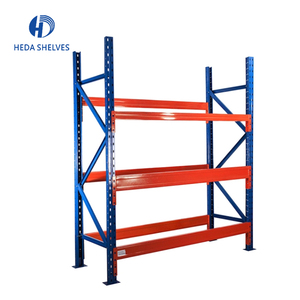
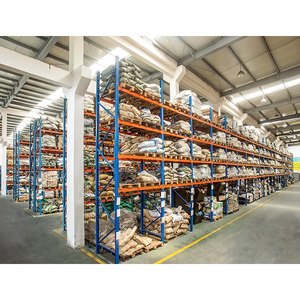
| Selective Pallet Rack | 35% - 40% | 100% Direct | 500 - 2,500 kg | 3.0m - 3.8m | Standard Counterbalance, Reach Truck | General Distribution, FMCG, 3PL Multi-Client Hubs |
| Very Narrow Aisle (VNA) | 50% - 58% | 100% Direct | 800 - 1,800 kg | 1.6m - 1.9m | VNA Turret Truck, Wire/Rail Guided | High-Density Warehouses with Tall Eaves (>12m) |
| Drive-In / Drive-Thru | 65% - 75% | LIFO / Low | 600 - 1,500 kg | Eliminates Aisles | Counterbalance, Reach Truck | Cold Storage, Seasonal Stock, Low SKU Count Bulks |
| Radio Pallet Shuttle | 75% - 85% | FIFO / LIFO | 500 - 2,000 kg | One Service Lane | Forklift + Autonomous Shuttle Cart | Food & Beverage, Deep Freeze, High-Volume Wholesalers |
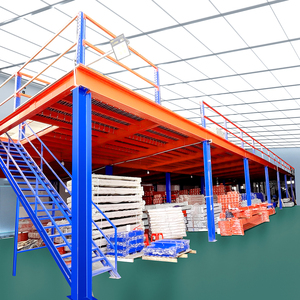
| Industrial Mezzanine Loft | Up to 200% | 100% Custom | 300 - 1,000 kg/m² | Pedestrian & Pallet Jack | Manual Jack, Freight Hoist, Conveyor | E-commerce Split Case Picking, MRO Parts Stores |
| AS/RS High-Bay Racking | 85% - 95% | Automated 100% | 500 - 3,000 kg | 1.4m - 1.6m | Automated Stacker Crane, Shuttle AS/RS | 24/7 Smart Logistics Hubs, Mega Distribution Hubs |
Future Procurement Trends in Warehouse Pallet Storage Systems
Global logistics infrastructure investments require long-term risk mitigation. In the face of raw material fluctuations, nearshoring, and rising automation adoption, procurement executives must evaluate multiple strategic horizons.
Total Cost of Ownership (TCO) vs. Initial CapEx
Procurement teams are shifting away from evaluating racking solely on price-per-ton. Long-term TCO analyses account for structural steel durability, paint adhesion under forklift friction, modular expansion capacity, and future relocation adaptability. Sourcing cold-rolled profiles with high-yield strength reduces overall steel weight by 12% while maintaining higher deflection safety margins (L/200).
Raw Steel Indexing & Strategic Hedging
International freight and steel coil market volatility have driven B2B buyers toward transparent raw-material indexing contracts. Direct partnerships with Chinese manufacturing plants allow overseas distributors to lock in hot-rolled and cold-rolled coil prices via transparent Shanghai Futures Exchange (SHFE) index contracts, reducing exposure to steel market spikes.
Standardized International Interoperability
Multinational companies operating regional cross-docks in North America, Western Europe, and Southeast Asia demand universal component compatibility. Modern manufacturing trends emphasize dual-punched uprights capable of accepting both traditional 75mm/50mm European hook connectors and American teardrop boltless beam clips, streamlining spares procurement across global multi-facility footprints.
Sustainable Coating & Green Steel Mandates
Global Scope 3 carbon accounting mandates are accelerating the demand for low-emission manufacturing. Forward-thinking suppliers adopt lead-free, low-VOC TGIC polyester electrostatic powder coatings and closed-loop phosphating pretreatment systems. Furthermore, scrap steel recycling efficiency in Chinese electric arc furnace (EAF) infrastructure allows lower embedded carbon metrics per rack frame.
Technological Frontiers in Industrial Storage Systems
The transition from passive steel structures to intelligent, sensor-monitored, and automation-integrated warehousing frameworks is transforming modern material handling.
AS/RS Stacker Crane & Micro-Tolerances
High-bay Automated Storage and Retrieval Systems (AS/RS) reaching heights of 30 to 45 meters require structural tolerances far more stringent than standard manual racking. Deflection tolerances under crane acceleration must not exceed strict FEM 9.831 guidelines. Chinese factories are now deploying high-precision multi-spindle automatic drilling systems and laser measurement verification to ensure upright straightness within 1:1000 tolerances.
IoT Structural Health Monitoring & Impact Sensors
Forklift impact damage to upright columns is the primary cause of warehouse racking collapse. The next generation of industrial racking integrates wireless IoT strain gauges, three-axis MEMS accelerometers, and acoustic emission sensors directly into column baseplates. These telemetry systems send real-time alerts to Warehouse Management Systems (WMS) whenever an impact exceeds critical structural safety thresholds, preventing catastrophic failures.
Advanced Finite Element Analysis (FEA) Modeling
Modern pallet storage rack engineering has evolved beyond empirical hand calculations. We utilize non-linear 3D Finite Element Analysis (FEA) simulating static dead loads, dynamic live pallet drops, seismic ground accelerations, and wind-load pressures on clad-rack warehouse structures. This computational modeling ensures optimal section moduli, reducing deadweight steel usage while boosting seismic resilience.
Frequently Asked Questions on Importing Warehouse Racking from China
Comprehensive engineering, regulatory, and logistics answers compiled by our chief structural engineers to streamline international bidding and procurement processes.
Q1: How does Chinese Q235B and Q355B steel compare to international standards like ASTM A36 or S355JR?
Q235B is an industry-standard carbon structural steel widely utilized for cold-formed warehouse uprights and beams, offering a minimum yield strength of 235 MPa and tensile strength of 370–500 MPa, making it chemically and mechanically comparable to ASTM A36 (USA) and EN 10025 S235JR (Europe). For high-bay, heavy-capacity racking systems or high seismic zones, we utilize Q355B low-alloy high-strength steel (minimum yield strength 355 MPa), which directly correlates to European S355JR and ASTM A572 Grade 50. Every batch is certified with official 3.1 Mill Test Certificates.
Q2: What certifications are required to clear customs and ensure legal compliance in the USA, Canada, and Europe?
For the North American market, storage racking must comply with ANSI MH16.1 specifications established by the Rack Manufacturers Institute (RMI), along with IBC (International Building Code) seismic requirements. In Canada, CSA A344 applies. For European imports, structural compliance with EN 15512 (structural design), EN 15620 (tolerances and clearances), and CE marking under the Construction Products Regulation (EN 1090-1 / EN 1090-2 Execution Class EXC2) is mandatory. Our manufacturing lines are ISO 9001:2015, ISO 14001, and ISO 45001 certified, with fully validated international compliance records.
Q3: When should a facility specify hot-dip galvanizing over electrostatic powder coating?
Electrostatic powder coating (thermosetting epoxy-polyester with a dry film thickness of 60–90 μm) is the optimal and cost-effective choice for dry, ambient-temperature distribution centers. Hot-dip galvanizing (HDG according to ISO 1461, yielding a zinc layer of 65–85 μm) is required for outdoor yard storage, corrosive chemical or fertilizer plants, coastal high-salinity air, and sub-zero cold-storage facilities (-20°C to -30°C) where constant condensation creates severe rust risks that powder coatings cannot withstand over decades.
Q4: How is maximum allowable beam deflection calculated under full rated pallet loading?
In accordance with ANSI MH16.1 and EN 15512 codes, the maximum permissible vertical deflection of a pallet rack load beam under uniform distributed load (UDL) is typically limited to L/200, where "L" represents the clear span distance between upright columns. For example, on a standard 2700mm beam carrying two 1000kg pallets, the deflection at the center point must not exceed 13.5mm (2700 / 200). For automated AS/RS cranes or sensitive automated shuttle systems, stricter deflection criteria of L/300 or L/400 are engineered into the box beam section design.
Q5: What details are needed from a client to produce an accurate engineering layout and quotation?
To prepare an accurate engineering drawing and formal quotation, our technical team requires: 1) Architectural CAD drawings showing column grid spacing, building envelope, overhead obstacles, clear height to roof trusses, and egress doors; 2) Concrete slab thickness, compressive strength (e.g., 28-day 30 MPa), and rebar layout; 3) Exact pallet specifications: length, width, overall height including cargo overhang, and gross weight; 4) Material handling equipment (forklift type, turning radius, maximum lift mast height); 5) Geographic site address for seismic acceleration (Ss, S1) calculations.
Q6: How do you prevent maritime corrosion, transit scratches, and bent steel during container shipping?
Structural steel rack components endure severe maritime transit environments. We mitigate shipping damage through heavy-gauge structural steel shipping bunks that prevent banding crush, vapor corrosion inhibitor (VCI) desiccant packs inside sealed plastic wraps, corrugated cardboard interleaving between finished beam layers, and heavy-duty corner protectors on roll-formed upright tabs. Every 40ft High Cube container is engineered using 3D cargo load-planning software to balance axle weight and maximize volumetric space without transit movement.
Q7: Can teardrop pallet rack profiles manufactured in China interlock with American-made teardrop beams?
Yes. We manufacture authentic, high-precision imperial teardrop pattern uprights engineered with universal 2-inch punch spacing centers, making them fully interchangeable with mainstream North American teardrop systems. This ensures seamless retrofit additions, replacement frames, and beam expansions for existing warehouses in the US, Canada, and Mexico without requiring complete system changeouts.
Q8: What fire-safety considerations must be engineered into rack designs for NFPA 13 sprinkler compliance?
Warehouse racking must respect transverse and longitudinal flue spaces to comply with NFPA 13 (Standard for the Installation of Sprinkler Systems). For back-to-back selective pallet racks, row spacers are sized to maintain a continuous 6-inch (152mm) longitudinal flue space. Wire mesh decking is heavily favored over solid timber or steel decking because its minimum 50% open area permits vertical water penetration from ceiling ESFR (Early Suppression, Fast Response) sprinkler heads down through all pallet tiers.
Accelerate Your Warehouse Capacity With Direct Factory Engineering
Whether you require standard selective pallet racking, deep-lane shuttle systems, or high-bay AS/RS engineering, our technical sales team delivers certified drawings, structural calculations, and competitive factory pricing tailored to your project schedule.