Precision Heavy-Duty Warehouse Storage Solutions
Explore our top-tier heavy-duty industrial storage racks and dynamic logistics systems, built with European design standards and compliant with North American seismic codes.
Why Global Supply Chains Rely On Our Engineering
We do not merely manufacture steel columns; we engineer total industrial structural integrity. Every installation operates under unified European structural precision backed by North American project management.
Unified Accountability
You avoid fragmented vendor communication. Every engineered project is assigned a dedicated triumvirate: an Account Manager, Project Manager, and Installation Manager, guaranteeing seamless oversight from slab analysis to the final sign-off.
Automation Integrator Synergy
Engineered to interface natively with the world's most advanced logistics automation. Our automated high-bay, miniload, and ROBORACK architectures integrate with Tier-1 automation providers such as Witron, Knapp, TGW, and Vanderlande.
Seismic & Permit Compliance
Every footprint is analyzed against localized seismic loads, soil strata, and building parameters under ANSI MH16.1 (RMI) and Canadian CSA A344 standards, ensuring rapid approvals by your local Authority Having Jurisdiction (AHJ).
Smart Range Fast Track (72h)
For urgent retrofit schedules and high-demand operations handling GMA 48"x40", CHEP, or Euro pallets, our proprietary Smart Range delivery network provides guaranteed dispatch windows within 72 hours via localized distribution hubs.
Proprietary CSA Engineering Tool
Our authorized dealer network utilizes automated calculation tools that algorithmically synthesize beam deflections, upright profiles, and safety factors, preventing human error during warehouse capacity expansions.
Strategic Evolution of Industrial Racking: 2025–2030
An engineering and supply chain analysis of vertical density, cold-chain expansion, dynamic load modeling, and automation convergence.
1. The Transition from Static Storage to Kinetic Fulfillment Platforms
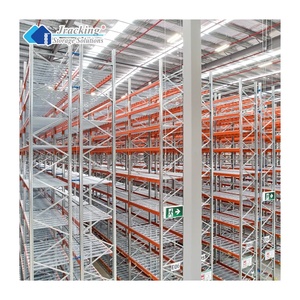
Industrial warehousing is undergoing a paradigm shift. Rising industrial land costs across North America and Europe have rendered traditional 24-to-32-foot low-bay selective racking economically unviable for Tier-1 supply chains. Modern capital expenditures are shifting almost exclusively toward vertical cubic density systems stretching up to 130+ feet (40+ meters) in automated clad-rack configurations, where the racking infrastructure forms the structural skeleton of the building envelope itself.
In modern distribution hubs, conventional selective shelving is being re-engineered into dynamic picking environments: carton flow systems feed pick-to-light interfaces, while deep-lane radio pallet shuttles replace standard forklift-operated drive-in racks. By removing the forklift operator from the storage lane, facilities mitigate impact collision damage, enhance inventory turnover (supporting FIFO or LIFO simultaneously), and dramatically elevate employee safety.
2. Cold Chain Surge and High-Density Optimization
The global perishable foods, pharmaceutical, and biologics sectors are experiencing sustained expansion. Because refrigerated and blast-freezer warehouse space demands significant energy per cubic meter, thermal conservation dictates maximum pallet density:
- Thermal Cycling Endurance: Ordinary structural cold-rolled steel becomes brittle under sustained sub-zero temperatures (-20°F to -40°F). Modern high-grade micro-alloyed steels with enhanced notch toughness and heavy-duty hot-dip galvanized finishes prevent micro-fracturing and rust due to condensation during defrosting cycles.
- Automated Deep-Lane Shuttles: Utilizing automated pallet shuttles within cold-storage environments eliminates heat-generating forklifts and prevents costly refrigerated air loss through cavernous open aisles.
3. Structural Micro-Tolerances Driven by AS/RS and Mobile Robotics (AMRs)
Historically, manual forklift operators compensated for minor beam deflections and floor unevenness through sight. However, as warehouses adopt automated stacker cranes, miniload systems, and Autonomous Mobile Robots (AMRs), allowable structural tolerance margins have tightened from quarter-inches to single millimeters:
- Deflection Under Static & Dynamic Forces: Automation mandates beam deflection ratios tighter than 1:200 to prevent optical sensor faults during high-speed crane travel.
- Floor Slab Anchorage & Dynamic Fatigue: Seismic IBC standards now demand complex nonlinear anchor bolt analysis to withstand sustained dynamic shock loading produced by rapid pallet deceleration in seismic zones 3 and 4.
4. Future Procurement Trends: Lifecycle Total Cost of Ownership (TCO)
Leading corporate procurement officers are adjusting their selection matrices away from initial steel purchase price toward Total Lifecycle Cost (TLC). Key evaluation criteria include:
- Modular Reconfigurability: The ability to adjust beam elevations, add mezzanine decks, or integrate pallet flow modules without field welding or engineering recertification delays.
- Impact Deflection Engineering: Upright base profiles reinforced with structural steel wraps or integrated sacrificial column protectors that can be replaced within 15 minutes, preserving business continuity.
- Traceable Material Provenance: Validated steel mill test certificates (MTRs) and verifiable structural documentation to simplify municipal permitting and OSHA warehouse compliance audits.
Industrial Racking Procurement: Frequently Asked Questions
Clear, engineer-verified guidance addressing structural calculations, permitting, load limits, and system conversions.
Compliance verification requires an engineering package detailing the dead load, live load, seismic coefficients (Ss, S1), and building slab capacity. In the US, calculations must align with ANSI MH16.1 (RMI standard) and the International Building Code (IBC). In Canada, compliance with CSA A344 is mandatory. Final approval rests with the local Authority Having Jurisdiction (AHJ) after review of signed and sealed engineering drawings.
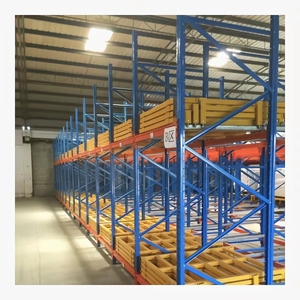
Push-back racks utilize nested wheeled carts rolling on inclined structural steel rails under gravity; forklifts manually push back stored pallets to load new ones (typically 2 to 6 pallets deep on a LIFO basis). Pallet shuttle systems utilize an autonomous, battery-powered cart operating inside deep channels (often 20+ pallets deep) that can run on either a FIFO or LIFO basis, eliminating forklift travel within the rack structure.
Under NFPA 13 guidelines, the requirement for in-rack fire sprinklers depends on warehouse clear height, commodity classification (Class I through IV or Group A Plastics), pallet composition (wood vs. plastic), and rack configuration. Maintaining longitudinal and transverse flue spaces (typically 6 inches clear) is essential to let heat trigger overhead ESFR sprinklers or to accommodate integrated in-rack piping.
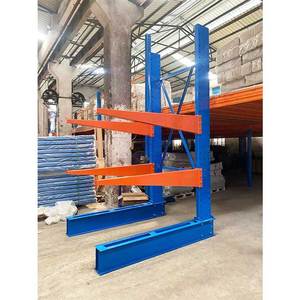
Standard industrial applications typically require a reinforced concrete slab thickness of 6 to 8 inches with a minimum compressive strength of 3,000 to 4,000 PSI. For tall selective racking, heavy cantilever towers, or high-bay AS/RS systems exceeding 30 feet, a 4,500+ PSI slab with specialized rebar placement or geo-pier subgrade reinforcement may be needed to prevent punch-through shear failure.
Standard selective racking cannot simply be converted to AS/RS without upfront structural provisioning. Automated systems demand tighter tolerances for deflection, plumbness, and beam rail interfaces, as well as specialized anchoring and guidance hardware. Specifying these tolerances at the initial engineering stage allows cost-effective phased automation upgrades in the future.
Transform Your Warehouse Throughput & Storage Density
Consult with our senior logistics application engineers. We evaluate your floor slabs, SKU movement velocity, and seismic requirements to configure the optimal high-density storage layout.