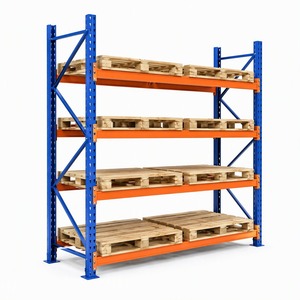
Industrial Racking Portfolio
High-Efficiency Warehouse Storage Architectures
Engineered to international safety codes (ANSI MH16.1 & CSA A344) and fully customized for distribution depots, cold vaults, and commercial logistics hubs across Sandy Point Town.
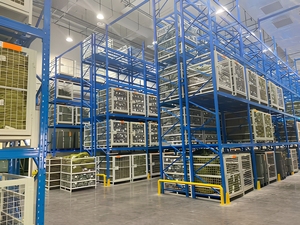
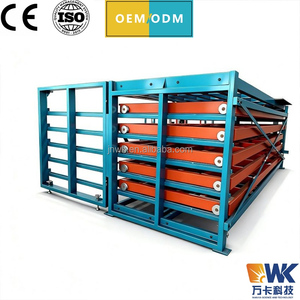
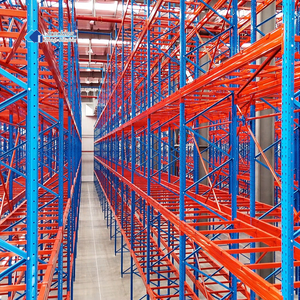
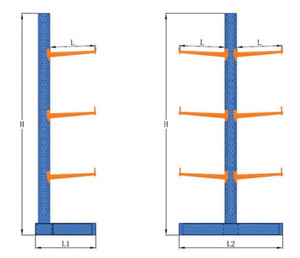
Technical Whitepaper Breakdown
Engineering Physics Behind Live Pallet Racking (Pallet Flow)
Live Pallet Racking, commonly classified in material handling engineering as Pallet Flow Racking, operates on an unpowered gravitational gradient design utilizing heavy-duty full-width steel or split cylindrical rollers inclined at a precise angle (typically 2.5% to 3.5%).
Deterministic FIFO Dynamic Flow
Unlike standard static push-back or drive-in solutions that impose Last-In First-Out (LIFO) limitations, live pallet racking ensures absolute stock rotation. Pallets loaded from the rear replenish aisle flow downward under controlled gravity toward the pick face. Once the front pallet is retrieved, the rear unit smoothly rolls into position, eliminating stock stagnation.
Centrifugal Speed Controller Dampeners
To safely convey loads ranging from 500 kg to beyond 1,500 kg per pallet, our beds are engineered with internal brake drums. These centrifugal roller dampeners absorb kinetic velocity, preventing runaway pallets. The system maintains an uncompromised constant descent speed of 0.25 to 0.30 m/s regardless of weight variance.
Load Separation Separator Escapements
A primary bottleneck in high-throughput gravity systems is line pressure buildup at the discharge face. Our live racks feature mechanical foot-operated or automatic separator escapements that isolate the lead pallet from upstream line pressure, allowing forklift masts to extract pallets cleanly without snagging or dragging adjacent freight.
Hyper-Local Context
Sandy Point Town & Leeward Saint Kitts Application Scenarios
As the historic second town of Saint Kitts, Sandy Point Town occupies a strategic geographical crossroad along the northwest coastline. Facing coastal humidity, import reliance, and distinct island supply-chain cycles, local operations require highly specialized storage engineering.
Perishable Food & Cold-Vault Wholesale
Supplying resorts, eco-lodges, and local supermarkets in Saint Anne Sandy Point Parish requires strict cold-chain integrity. In temperature-controlled cold vaults (-20°C to +4°C), cubic refrigeration costs are exceptionally high. Live racking compacts storage, cuts refrigerated air volume wastage by 60%, and automates FIFO rotation for dairy, frozen meats, and perishables arriving via Port Zante.
Construction & Hardware Bulk Inflow
With ongoing infrastructural expansion throughout Saint Kitts and Nevis, construction merchants and import stockists in Sandy Point require deep-lane systems. Live pallet racks handle uniform stock—such as bagged Portland cement, bagged aggregates, tiles, and hardware fixtures—keeping loading pathways separate from warehouse traffic.
Pharmaceutical & Emergency Depot Staging
Sandy Point serves as a vital logistics node for medical supplies and hurricane disaster-preparedness stocks for the northern districts of Saint Kitts. Using live racking, emergency food rations, pharmaceuticals, and critical aid materials maintain guaranteed chronological batch rotation, preventing expiry waste while remaining instantly accessible.
Regional Evolution
Emerging Warehouse & Logistics Trends in Sandy Point Town
Strategic modernization trends shaping industrial storage demand across the Federation.
| Logistics Trend Vector | Local Market Catalyst | Live Racking Engineering Adaptation | Impact on ROI |
|---|---|---|---|
| Curbing Maritime Import Bottlenecks | Irregular container shipping schedules require holding higher buffer inventories in Basseterre and Sandy Point. | Deep-lane 10-to-15 pallet flow channels maximize cubic volumetric storage per square meter without adding footprint. | Decreases cost per pallet position by 38% compared to traditional wide-aisle static racks. |
| High Energy Costs & Cold Chain Growth | Saint Kitts power grid tariffs demand maximum cubic efficiency inside walk-in freezers and cold storage facilities. | Live racking eliminates redundant service aisles, concentrating thermal cooling mass exclusively across product loads. | Cuts active refrigeration compressor run-hours by approximately 22% annually. |
| Seismic & Hurricane Structural Resilience | Eastern Caribbean seismic zone categorization along with Atlantic hurricane exposure (Category 4-5 wind shear). | Heavy-duty boxed baseplates, chemical dynamic anchoring, and braced upright columns complying with ANSI MH16.1. | Mitigates rack beam displacement and product spillage during tropical storms or tremors. |
| Harsh Marine Atmospheric Exposure | Extreme coastal salinity and trade winds blowing off the Caribbean Sea accelerating galvanic steel degradation. | Multi-stage hot-dip galvanization (HDG) or zinc-rich electro-deposition with epoxy powder topcoats (C4/C5 rated). | Extends system operational lifecycle beyond 25 years without structural frame pitting or flaking. |
Why Choose Our Export Engineering
Enterprise Advantages Built on Technical Authority
Combining European structural safety tolerances with direct-from-manufacturer pricing, global sea freight support, and dedicated project engineering teams.
Dedicated 3-Expert Project Oversight
Every industrial project is managed by three assigned specialists: an Account Manager, a Senior Project Engineer, and an Installation/Commissioning Manager. From structural calculations to final anchor verification, accountability stays unified under one roof.
Free 24h Parametric CAD & Load Modeling
Send us your building perimeter dimensions, floor slab load thresholds, clear eaves height, and forklift specifications. Our engineering desk delivers comprehensive 2D CAD layouts and 3D cubic utilization simulations within 24 hours, completely free of charge.
Caribbean Full Container Export Logistics
We handle heavy break-bulk and 40ft High Cube container shipping to Port Zante, Basseterre, coordinating onward freight transit into Sandy Point Town. Cargo is bundled with weather-sealed seaworthy protective wrapping to prevent transit moisture corrosion.
ANSI MH16.1 & CSA A344 Code Compliance
All upright columns, roll-formed profile beams, and load bearings undergo FEA stress analysis and certified physical testing, verifying conformance with North American and European seismic, wind-uplift, and structural integrity standards.
Universal GMA & Euro Pallet Compatibility
Our gravity beds accommodate standard North American 48" x 40" GMA pallets, CHEP blue blocks, heavy industrial skids, and Euro-spec EPAL pallets (1200 x 800 mm). Custom lane-width profiles prevent edge binding across diverse pallet types.
Purchasing Knowledge Base
Frequently Asked Questions by Sandy Point Wholesalers
Practical engineering and commercial answers for warehouse managers and logistics directors.
How does coastal air in Saint Kitts affect the longevity of pallet flow tracks?
Sandy Point Town is situated along the Caribbean Sea, exposing industrial buildings to high ambient humidity and salt spray. For live pallet racking, standard plain paint finishes degrade quickly. We provide heavy-duty pre-galvanized framing, hot-dip galvanized roller axles, sealed shielded precision ball bearings, and specialized marine-grade electrostatic epoxy coatings to ensure decades of corrosion-free performance.
Can our existing counterbalanced or reach forklifts service a live racking system?
Yes. Live pallet racking does not require articulated or narrow-aisle (VNA) forklifts because operators never drive inside the rack structure itself. Standard counterbalanced trucks load freight at the replenishment aisle, while common reach trucks or stackers pick at the opposite discharge face. This cuts aisle cross-traffic and minimizes rack impact accidents.
What happens if a damaged or non-standard wooden pallet enters the flow lane?
Broken bottom runners or protruding nails can snag on single-roller beds. We mitigate this using multi-track staggered cylindrical steel rollers or continuous full-width roller tracks paired with high-tensile guide entries. Additionally, pallet inspect-and-reject stations at the infeed aisle ensure only structurally sound skids enter the gravity bed.
How are import freight duties, shipping, and port clearance handled for St. Kitts?
We export under structured Incoterms (CIF Port Zante, Basseterre, or DDU/DAP directly to Sandy Point Town). We furnish full engineering packing manifests, mill test certificates, certificate of origin, and certified load capacity placards to streamline customs processing through the Saint Christopher and Nevis Customs and Excise Department.
What minimum floor slab thickness and strength is required for live pallet racking?
Because live racking concentrates high dead and live loads into compact column clusters, floor slab design is critical. We recommend a reinforced concrete slab of at least 150 mm to 200 mm thickness with a compressive strength of 25 to 30 MPa (approx. 3,500 to 4,000 PSI). Our structural engineers calculate baseplate footprints and chemical anchor embedments tailored to your specific foundation conditions.
Direct Exporter & Engineering Consultation
Transform Your Sandy Point Warehouse Logistics
Connect with our technical storage engineering specialists today. Get a customized 24-hour CAD spatial plan, seismic verification calculation, and competitive factory-direct export wholesale pricing.
Send an Inquiry